
TK 210 ELISA
Quantitative TK1 biomarker assay for cancer monitoring
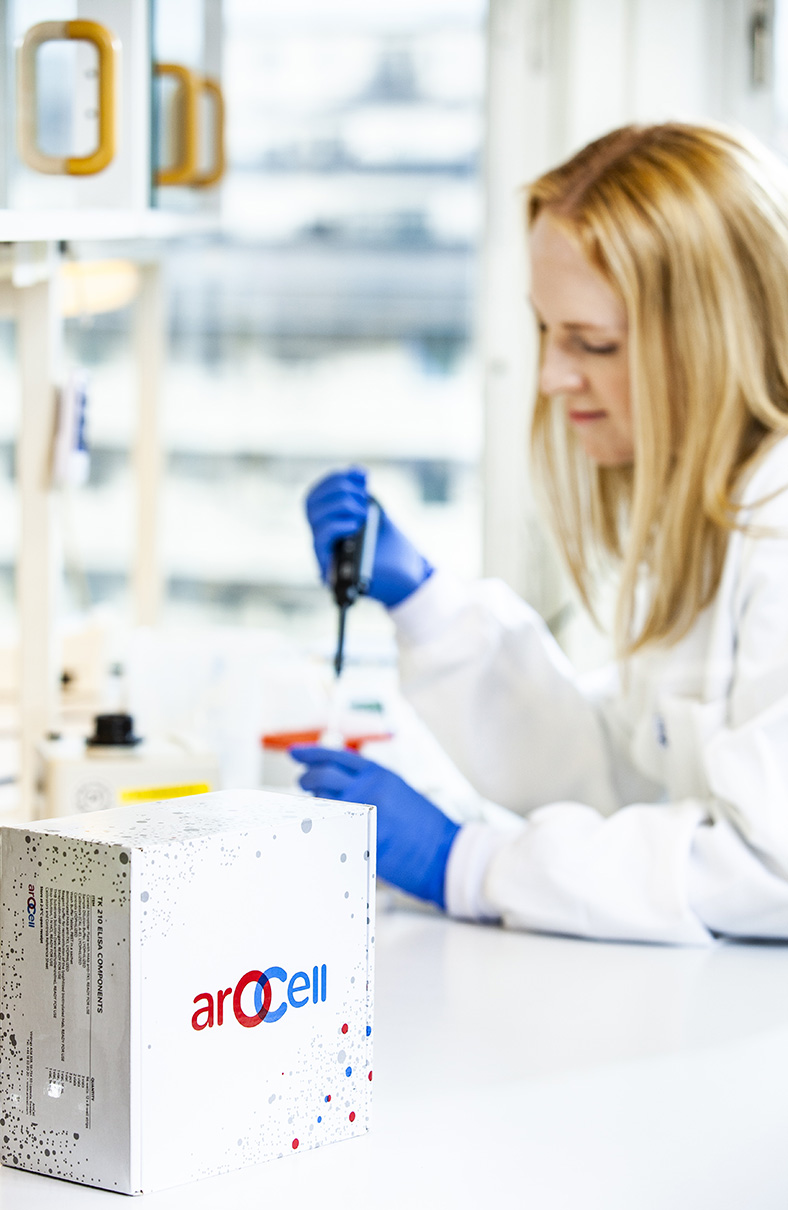
AroCell TK 210 ELISA is a laboratory-based immunoassay that measures thymidine kinase 1 (TK1) levels in blood. TK1 is an enzyme associated with DNA synthesis and cell proliferation, making it a valuable biomarker for assessing tumor activity.
TK1 is a well-established biomarker associated with cell proliferation. Elevated TK1 levels are linked to increased tumor activity, making it a valuable tool for monitoring cancer progression and treatment response.
What is AroCell TK 210 ELISA?
AroCell TK 210 ELISA is a laboratory-based immunoassay that measures thymidine kinase 1 (TK1) levels in blood. TK1 is an enzyme associated with DNA synthesis and cell proliferation, making it a valuable biomarker for assessing tumor activity.
TK1 is a well-established biomarker associated with cell proliferation. Elevated TK1 levels are linked to increased tumor activity, making it a valuable tool for monitoring cancer progression and treatment response.
The role of TK1 as a cancer biomarker
Thymidine kinase 1 (TK1) is an enzyme involved in DNA synthesis. Its expression increases during active cell division and is typically elevated in proliferating tumor cells.
Measurement of TK1 levels provides insight into tumor biology, including:
- Tumor growth rate
- Disease progression
- Response to therapy
What are the key benefits of AroCell TK 210 ELISA for cancer monitoring?
- Quantitative biomarker assay for tumor proliferation
- Supports monitoring of disease progression and treatment response
- Enables longitudinal tracking of cancer dynamics
- Applicable across multiple cancer types, including solid tumors
- Compatible with standard laboratory workflows and automation
Clinical applications in oncology
AroCell TK 210 ELISA supports clinicians in:
- Evaluating tumor aggressiveness
- Monitoring treatment response over time
- Detecting early signs of relapse
- Supporting clinical decision-making in oncology
Why choose AroCell TK 210 ELISA for tumor profileration analysis?
Understanding tumor proliferation is key to effective cancer management.
By providing quantitative data on cell turnover, AroCell TK 210 ELISA supports clinicians in making more informed decisions regarding treatment and follow-up strategies.
Thymidine Kinase 1
TK1 biology: TK1 has been shown to be both a prognostic and treatment predictive marker, particularly useful for advanced prostatecancer. AroCell TK 210 ELISA provides valuable information that can be used for predicting and monitoring patients to help clinicians to optimize treatment.
Thymidine kinase is an enzyme that is exclusively produced by proliferating cells. This is similar to KI-67 and PCNA, tissue biomarkers that are universally used tissue markers and established to reflect tumor cell proliferation.
Thymidine kinase can be measured as enzyme activity or as protein concentrations. Thymidine kinase is not necessarily enzymatically active (Bitter et al., PMID 33292474), resulting in activity assay results may differ from estimations of thymidine kinase levels using various antibodies (Jagarlamudi et al PMID36201558). The activity of the enzyme is controlled allosterically by levels of dTTP and enzyme activity is a ected by post-translational modifications such as phosphorylation of serine residues (Munch-Petersen B et al., Human thymidine kinase 1. Regulation in normal and malignant cells. Adv Enzyme Regul. 1995;35:69–89).
In serum from patients with solid tumors, activity assays may differ from measurements using the AroCell TK 210 ELISA. It has been reported that TK 210 ELISA had higher sensitivity (59% and 44%) compared to enzymatic measurments (47% and 25%) is breast and prostate cancer sera (Jagarlamudi et al PMID36201558). It has also been demonstrated that factors may be present in serum that may inhibit TK1 enzymatic activity (Concentration of thymidine kinase 1 in serum (S-TK1) is a more sensitive proliferation marker in human solid tumors than its activity. He Q, Zhang P, Zou L, Li H, Wang X, Zhou S, Fornander T, Skog S. Oncol Rep. 2005 Oct;14(4):1013-9).
How does AroCell TK210 Elisa support bladder cancer monitoring?
In bladder cancer, biomarkers that reflect tumor biology can complement traditional diagnostic tools. TK1 measurement provides additional insights into tumor cell activity, supporting a more complete understanding of disease progression and patient status.
Integration of AroCell TK210 Elisa into laboratory workflows
AroCell TK 210 ELISA is designed for routine laboratory use and can be easily integrated into existing diagnostic workflows.
It is suitable for:
- Clinical laboratories and research settings
- Compatible with standard ELISA platforms
- Supports automation and high-throughput workflows
- Easily integrated into monitoring programs
Find more information
The application of the AroCell TK 210 ELISA and the use of TK1 have been successfully used and described in several publications.
Clinical Evaluation
The application of the AroCell TK 210 ELISA and the use of TK1 have been successfully used and described in several publications.
*Rör ej*
Your content goes here. Edit or remove this text inline or in the module Content settings. You can also style every aspect of this content in the module Design settings and even apply custom CSS to this text in the module Advanced settings.
General
1. Zhou, J. et al. (2013). The Proliferation Marker Thymidine Kinase 1 in Clinical Use. Review. Molecular and Clinical Oncology 1: 28.
2. Alegre, M.M. et al. (2012). Thymidine Kinase 1 Upregulation is an Early Event in Breast Tumor Formation. Journal of Oncology. Volume 2012, Article ID 575647, 5 pages.
3. Guan, H. et al. (2009). Thymidine Kinase 1 Expression in Atypical Ductal Hyperplasia Significantly Differs from Usual Ductal Hyperplasia and Ductal Carcinoma In-Situ: A Useful Tool in Tumor Therapy Management. Mol Med Rep. 2(6): 923-9.
4. Alegre, M.M. et al. (2013). Thymidine Kinase 1: A Universal Marker for Cancer. Cancer and Clinical Oncology. 2(1): 2013.
5. Bjöhle, J. et al. (2013). Serum thymidine kinase activity compared with CA 15-3 in locally advanced and metastatic breast cancer within a randomized trial. Breast Cancer Res Treat. 139(3): 751-8.
6. Chen, F. et al. (2013). Serum thymidine kinase 1 levels predict cancer-free survival following neoadjuvant, surgical and adjuvant treatment of patients with locally advanced breast cancer. Molecular and Clinical Oncology. 1: 894-902.
7. He, Q. et al. (2006). Thymidine kinase 1 in serum predicts increased risk of distant or loco-regional recurrence following surgery in patients with early breast cancer. Anticancer Research 26: 4753-4760.
8. Jagarlamudi, K.K. et al. (2015). Breast and prostate cancer patients differ significantly in their serum Thymidine kinase 1 (TK1) specific activities compared with those hematological malignancies and blood donors: implications of using serum TK1 as a biomarker. BMC Cancer 15:66.
9. Kumar, J.K. et al. (2016). A clinical evaluation of the TK 210 ELISA in sera from breast cancer patients demonstrates high sensitivity and specificity in all stages of disease. Tumor Biology. 37: 11937.
Prostate
Serum Markers as predictors for treatment benefit in castration-resistant prostate cancer.
Szarvas T, Kramer G, Jagarlamudi K, Styrke J, Linder S.
Urol Oncol. 2025, 43(11):664.e11-664.e17.
Elevated Levels of Serum Thymidine Kinase 1 Predict Poor Survival for Patients with Metastatic Prostate Cancer. Murtola TJ, Siltari A, Raittinen P, Tammela TLJ, Linder S, Csizmarik A, Kramer G, Szarvas T.
Eur Urol Open Sci. 2024, ;70:135-141.
Breast
A clinical evaluation of the TK 210 ELISA in sera from breast cancer patients demonstrates high sensitivity and specificity in all stages of disease.
Kumar JK, Aronsson AC, Pilko G, Zupan M, Kumer K, Fabjan T, Osredkar J, Eriksson S. Tumour Biol. 2016;37(9):11937-11945.
DLBCL
18. Jaffe ES, Harris NL, Stein H, et al., editors. World Health Organization classification of tumours. Pathology and genetics of tumours of haematopoietic and lymphoid tissue. Lyon: IARC Press; 2001.
19. A predictive model for aggressive non-Hodgkin’s lymphoma. The International Non-Hodgkin’s Lymphoma Prognostic Factors Project. N Engl J Med 1993; 329:987–994.
20. Sehn LH, Berry B, Chhanabhai M, et al. The revised International Prognostic Index (R-IPI) is a better predictor of outcome than the standard IPI for patients with diffuse large B-cell lymphoma treated with R-CHOP. Blood 2007;109;1857–1861.
21. Suzuki K, Terui Y, Yokoyama M, et al. Prognostic value of high thymidine kinase activity in patients with previously untreated diffuse large B-cell lymphoma treated by rituximab, cyclophosphamide, doxorubicin, vincristine, and prednisolone. Leuk Lymphoma. 2013; 54:2412–2417.
22. Erisksson S. Thymidine kinase 1 in diffuse large B-cell Lymphoma revisited in the Rituximabera. AroCell internal report (70-09CL22001-01).
Ovarian
Clinical Significance of the TK1-Specific Activity in the Early Detection of Ovarian Cancer.
Osredkar J, Jagarlamudi KK, Cviič D, Škof E, Cvjetićanin B, Zore A, Lukanović D, Eriksson S, Meglič L.
Oncology. 2024, 102(1):17-29.
A Dual Biomarker TK1 Protein and CA125 or HE4-Based Algorithm as a Better Diagnostic Tool than ROMA Index in Early Detection of Ovarian Cancer. Cviič D, Jagarlamudi K, Meglič L, Škof E, Zore A, Lukanović D, Eriksson S, Osredkar J. Cancers (Basel). 2023;15(5):1593
Oncology
Diagnostics for oncology
Cancer is one of the leading causes of death worldwide, despite advancing knowledge. To improve cancer patient management, there is a clear need for efficient diagnostics tools to capture this critical clinical data.

Bacteriology
An effective typhoid test
Typhoid fever is water and food-borne infectious disease caused by the bacterium, Salmonella enterica. IDL Biotechs product TUBEX® TF, is a rapid and sensitive in vitro diagnostic test for the detection of acute typhoid fever.

Investors
We are listed on NASDAQ First North Growth Market.
We want to be the obvious choice within our segment in the markets where we are established. The market for our products is large and we are a smaller player with significant growth potential so far. IDL Diagnostics is unique for a company of this size.